



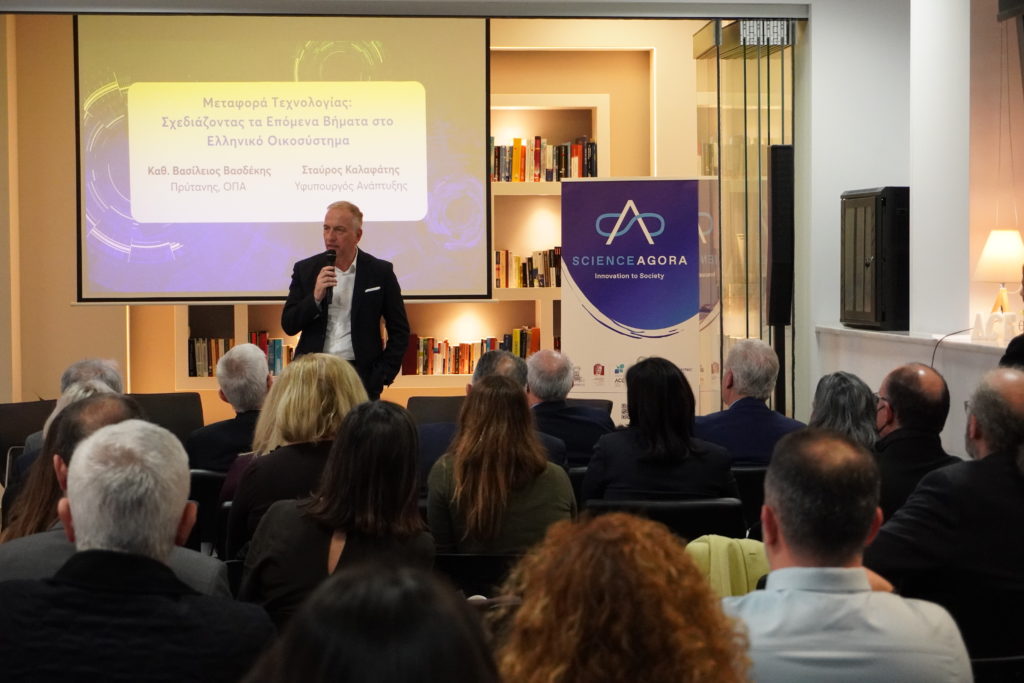
How can Greece accelerate the journey from research excellence to market impact? This question was at the heart of the event “Technology Transfer: Designing the Next Steps for the Greek Innovation Ecosystem”, held on 6 April at the Athens Center for Entrepreneurship and Innovation (ACE) of the Athens University of Economics and Business (AUEB).
The event was organised by the strong partnership of four top academic and research institutions based in Athens (NCSR Demokritos, ACE – Athens University of Economics and Business Center for Entrepreneurship and Innovation, National Technical University of Athens, ATHENA Research Center), Science Agora – Innovation To Society, in collaboration with the Technology Transfer Networks Gefyra Technology Transfer, ROMVOS, SPEIRA+, TETRIS, and WINET2, with the support of the Hellenic Network of Technology Transfer Offices (METEX) and under the auspices of the General Secretariat for Research and Innovation (GSRI).
Bringing together representatives from academia, research organisations, government, technology transfer offices, investors and innovation stakeholders, the event provided a platform for constructive dialogue on strengthening Greece’s technology transfer ecosystem and enhancing the commercialization of research outcomes.
Strengthening the Technology Transfer Landscape
Discussions focused on key priorities for the future of technology transfer in Greece, including:
- the evolving institutional and regulatory framework;
- the adoption of common standards and best practices across Technology Transfer Offices;
- intellectual property management and research valorisation;
- the role of Venture Capital funds in supporting research-based innovation;
- sustainable funding models for Technology Transfer Offices and the challenges they continue to face.
The event highlighted the growing importance of coordinated action among universities, research centres, public institutions and the investment community in creating a mature and competitive innovation ecosystem.
Opening remarks were delivered by Professor Vassilis Vasdekis, Rector of the Athens University of Economics and Business, and Mr. Stavros Kalafatis, Deputy Minister of Development. The presence of Mr. Dimitris Terzis, Secretary General for Research and Innovation, further underscored the strategic importance of strengthening innovation policies and reinforcing the connection between research and industry.
From Strategy to Implementation: The PoC for Emerging Technologies Programme
Beyond policy discussions, the event also highlighted a concrete initiative that translates strategy into action: the PoC for Emerging Technologies programme, implemented by Science Agora – Innovation To Society in collaboration with the Hellenic Development Bank (HDB).
The programme represents an important milestone for the Greek innovation ecosystem by supporting the development of Proof-of-Concept (PoC) projects that bridge the gap between scientific research and market application.
By providing dedicated support to universities and research centres, the initiative enables research teams to validate promising technologies, test innovative solutions under real-world conditions and advance their readiness for commercial exploitation.
Such initiatives play a vital role in empowering researchers, supporting the creation and growth of research-based start-ups and spin-offs, and strengthening Greece’s capacity to transform scientific excellence into products, services and technologies with tangible economic and societal impact.
Building an Innovation Ecosystem through Collaboration
The discussions throughout the event reinforced a common understanding: successful technology transfer depends not only on scientific excellence, but also on strong institutional collaboration, access to funding, effective intellectual property management and a shared vision among all actors of the innovation ecosystem.
Programmes such as PoC for Emerging Technologies demonstrate how strategic partnerships can provide researchers with the tools needed to move beyond the laboratory, reduce technological risk and accelerate innovation towards market adoption.
As Greece continues to strengthen its national innovation ecosystem, initiatives that combine policy dialogue with practical funding opportunities will remain essential for supporting research commercialization, attracting investment and fostering sustainable economic growth.
Science Agora and its partners remain committed to advancing technology transfer, promoting innovation and creating new opportunities for researchers and entrepreneurs to transform scientific knowledge into real-world impact.


SOCIAL CONNECT